If you have plans to visit the beautiful Hawaiian Islands during the month of August, you’ll find everything you need to know and, quite possibly, more that you’ve even considered. From our many travels to Hawaii, we’ve learned many tips and tricks. We hope our insights from our August travels will help you make the most of your Hawaii vacation.
What to expect from Hawaii’s weather in August
August is a summer month and the weather will feel summery. For temperatures, August is one of Hawaii’s warmest months, but the tradewinds help the climate feel more pleasant. You can expect the daytime high temperatures to average in the mid-80s Fahrenheit (roughly 29° to 30°C). Nighttime lows typically dip to the mid-to-lower 70s Fahrenheit (23-ish °C).
Historically, August is not known as a rainy month in Hawaii. In fact, rainfall levels in August tend to be the third lowest of the year for the Hawaiian Islands. So, you’ll likely enjoy blue skies and spectacular sunsets.
Now, let’s talk about hurricanes. First, hurricanes are rare events in Hawaii. That being said, the month of August is one of the peak months for hurricanes in the Central Pacific Region, which includes the Hawaiian Islands plus thousands of miles around Hawaii. Only two hurricanes have made landfall in Hawaii in more than 75 years. The probability of a hurricane affecting Hawaii is unlikely, but it’s worth noting that it’s not impossible either. Out of curiosity, I asked Duck.ai to determine the probability of a hurricane hitting Hawaii this August, the result was roughly 0.2% to 0.4%. You can check the Central Pacific Hurricane Center for the most up-to-date information and learn more about hurricane season in Hawaii.
Hurricane Update: Tropical Storm Lala is threatening Hawaii as of August 15, 2026.
For more weather details, see our Hawaii weather guide.
What to pack for an August vacation in Hawaii
As we’ve mentioned, it’s summer, so expect heat and humidity. You’ll want to wear clothes that will help maximize your comfort. Based on our numerous trips the the Hawaiian Islands, here’s a cheatsheet of what works best
What to pack for daytime wear for beach or sightseeing
These are the types of clothing that we wear most often during the day in Hawaii:
-
- Swimsuits (Bring at least two suits per person so that you’ll have a dry suit to wear each day.)
- Swimsuit cover ups
- Rash guard shirts
- Quick-drying, moisture-wicking tops with sun protection (Hanes makes a very affordable performance shirt that we probably have a dozen of between us. It’s their Cool Dri tops. They’re quick-drying, moisture-wicking and they have built in UPF 40 sun protection. I have even used the women’s long-sleeve version as a rash guard.)
- Other shirts, like t-shirts – We recommend wearing light colors that don’t absorb the sun’s warmth as much to help keep you as cool as possible.
- Quick-drying, moisture-wicking shorts, skorts, and/or trousers depending on your activities
- Rainproof, breathable jacket – for examples, for women, highly recommend this Columbia waterproof jacket, which is what I have. For men, this jacket by 33,000ft is a good, affordable option. For kids, this SaphiRose waterproof rain jacket has a lot of great features and is reasonably priced. If you are wondering why you should bring a rainproof, breathable jacket, see our article: Where do you need a jacket or coat in Hawaii?
- Hat or visor
- Sunscreen (See our recommended sunscreens for a Hawaii vacation. Note that you should use a sunscreen that’s Hawaii 104 Act Compliant, meaning that it’s made without Octinoxate and Oxybenzone. Additionally note that Maui County has banned the sale of chemical sunscreens.)
- Lip balm with sunscreen (Our favorite mineral-based lip balm is this water-resistant Burt’s Bees SPF 30 that comes in three tropical flavors.)
- For daytime shoes, we recommend flip flops for the beach and pool and close-toe, performance sandals for hiking and sightseeing. See our guide to the essential shoes for a Hawaii vacation.
What to pack to wear for evening/ dinner in Hawaii
For evening wear, you can leave the fancy clothes at home because Hawaii’s dress code is casual. Ladies might want to pack summer dresses or perhaps resort-wear tops with nice shorts, skorts, or trousers. For men, we suggest you pack summery shirts, like polos or short-sleeve button downs, along with nice shorts. If you have clothing with “Hawaiian prints” they’ll be perfect to wear on your Hawaii vacation.
For more expert packing tips we’ve developed from our many trips to Hawaii, see our Hawaii vacation packing guide. We provide many more packing recommendations, including specialized shoes and gear to bring for tours.
Where to stay based on the warmer weather of August
You might be expecting location-based recommendation, but what we suggest is actually much more simple than that. We highly recommend you stay in accommodations with air conditioning. With the heat and humidity being high, having a place to shower and sleep with air conditioning is so much more pleasant.
From our experiences, most Hawaii hotels have air-conditioned rooms. We have stayed in two hotels — Hotel Molokai (before they added air conditioning to their garden-view rooms) and Hana-Maui Resort — that didn’t have air conditioning. If we could have changed one thing about those stays, we would have appreciated air conditioning.
If you are opting for a VRBO condo or other vacation rental, that’s where you have to be careful to check if your prospective vacation condo or villa has air conditioning. We’ve stayed in a couple of Hawaii vacation rentals without air conditioning and we really wished we had air conditioning. When searching for vacation rentals, look for filters that allow you to filter for rentals with air conditioning.
Hawaii ocean conditions in August
Ocean temperatures are warm enough for year-round swimming in Hawaii. In August, temperatures are warming up to around 80°F in Honolulu.
Typically, the ocean tends to be the most calm in the summer months compared to the rest of the year. With the calmer conditions, some adventures are more likely to take place. For example, only during the summer months can you take a kayak tour of Kauai’s Na Pali Coastline or take a boat tour of the Na Pali Coast that departs from the North Shore. (Note boat tours of the Na Pali Coast tend to operate from the South Shore of Kauai throughout the year.) From Maui, you’re more likely to be able to take a snorkel tour to Honolua Bay.
Though overall ocean conditions tend to be calm in August, no matter what time of the year you visit the Hawaiian Islands, you must respect the power of the ocean. It’s very, very important to know ocean safety.
Experts advise swimming at Hawaii beaches that are monitored by lifeguards. For snorkeling, We recommend you choose an organized-tour company as they are more informed of the safer spots and tend to keep an eye out for their snorkelers’ safety.
Hawaii stargazing in August 2027
Hawaii is an amazing place to stargaze due to the limited light pollution. So, do take advantage of the opportunity to see the stars. Ideally, you’ll want the sky to be as moonless as possible to maximize star and planet visibility. August 2 and August 31 will be the darkest nights, though the days before and after will offer a good bit of nighttime darkness, too. Check for moonrise and moonset times here.
In August 2027, there are several of special astronomy events:
- The Perseids Meteor Shower runs from July 17 through August 24, with the peak period on the night of August 12 and morning of August 13. At its peak, experts estimate 100 meteors per hour.
- The full moon will be on August 17.
- On August 17, there will be a penumbral lunar eclipse. This event happens when the Moon passes through the Earth’s partial shadow. During this type of eclipse, the Moon will darken slightly but not completely. Hawaii will be in a great position to observe this eclipse per this NASA information.
Natural occurrences in Hawaii in August
Mango season runs from late May to September with peak ripeness occurring in July and August. Check out a farmers market or roadside stand to taste delicious, Hawaii-grown mangos.
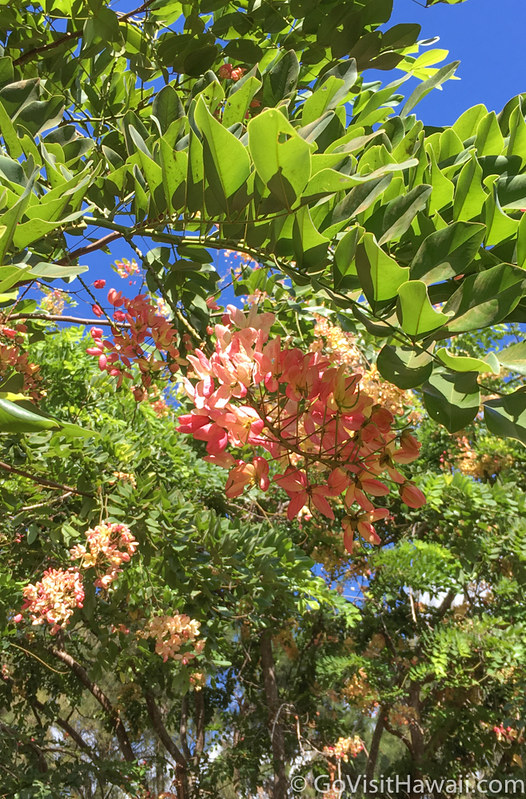
Rainbow Shower Trees are in bloom in Hawaii. I love their large, colorful blooms.
August Cultural Festivals & Special Events
Note that the following events are from 2026. They will be updated for 2027 in 2027. In the meantime, check the links to get an idea of the types of events that will likely be recurring at about the same time for 2027.
Checking out a festival is a fun way to learn about the local culture. No matter the type of festival, there’s usually music, food, dance, crafts, and art involved, too. Here’s what’s happening August 2026:
Oahu
August 2: The 85th Annual Na Hula Festival
August 20-23: Made in Hawaii Festival
August 14-24: Duke Kahanamoku OceanFest
August 29: 44th Annual Hawaiian Slack Key Festival Waikiki Style
Hawaii, Big Island
July 31-August 2: La Hae Hawai’i (Hawaiian Flag Day) Celebration
August 15: 54th Annual Ho’oku’ikahi Hawaiian Cultural Festival
August 15-16: Hana No’eau Hawaiian Arts Festival
Maui
August 22: Emma Farden Sharpe Hula Festival
Kauai
August 1-2: Heiva I Kauai international Tahitian Dance Competition
Is August a crowded month for a Hawaii vacation?
Hotel occupancy tends to be higher towards the earlier part of the month with families finishing up summer vacations before the new school year starts. When the Labor Day holiday falls near the end of August, that can also be a busier time, however, in 2026, Labor Day is on the latest possible date, September 7th, therefore, the end of August 2026 should not result in increased visitor arrivals for Labor Day weekend. Overall, visitor numbers have been slightly lower than normal in 2026.
No matter what time of year you go to Hawaii, we always advise you to consider where you’ll need reservations as we don’t want you to miss out on anything. See these articles with recommendations on what you should pre-book.
- Reservations needed for Oahu vacation
- Reservations needed for Maui vacation
- Reservations needed for Hawaii, Big Island vacation
- Reservations needed for a Kauai vacation
Additional notes about a Hawaii vacation in August
If you need suggestions for what to see and do on your Hawaii vacation, check out our Hawaii vacation itineraries which ensure you get to experience all the “must see and do” sights and activities.
We hope you have an incredible August vacation in the beautiful Hawaiian Islands!