Archive for the 'Volcano' Category

imageOh!
My!
Goodness!

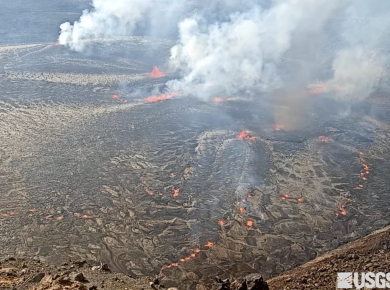
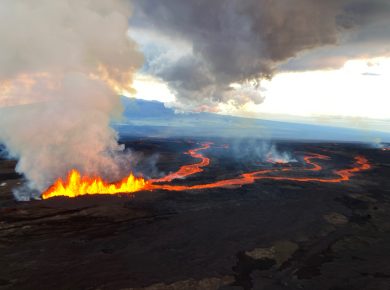
Lava has suddenly started moving rapidly towards the ocean at a clip of a half mile per day.  If you click on the Hawaii Volcano Observatory image on the left, you’ll be able to see an expanded map with a legend.  As of today, from the image, it appears that the lava is approximately a half mile from the ocean.

As I reported last week, lava viewing through Royal Gardens has been off limits, but, in a new development, the Star Bulletin is reporting that Hawaii County is preparing a lava viewing site.

“By the end of this week, we’ll have a nice safe place for people to view one of nature’s greatest wonderments, its power, its creativity,” said Mayor Harry Kim.

My heart started pounding quicker when I learned that the lava may be flowing to a point I could actually see it.  I’m going to the Big Island next week and in the past, I’ve never been lucky enough to see the lava from the ground, only from the air.  So, I hope that in the next three weeks, God willing, I’ll be able to bring you some current photos and video of the lava flow.  Please keep your fingers crossed. 

March 5th UPDATE:  A lava viewing point is being readied, per this Star Bulletin Article.   

 ———————

As I mentioned yesterday, you can’t take a short hike out to see the lava flow on the Big Island. Let me refine that statement. It is technically feasible to take a three-mile (six miles roundtrip) hike out to see flow, however access to the remote area is restricted. Why is it restricted? The area is supposed to be off limits to sightseers because it is dangerous. If you are considering ignoring the warning signs, please take a couple of minutes to watch this news segment.

So, let’s say you are an avid hiker and a six-mile hike is just a walk in the park for you. Let me tell you, walking over hardened lava is not easy at all. I think the USGS describes the challenge well:

Because of their surface irregularities, you should allow twice the time you think the walk might take. If a ranger tells you it is 3 miles (5 km) to the flows, consider it the equivalent of walking 5 to 6 miles (8-10 km) on a smoother surface. (Also, don’t forget that the return trip always seems twice as long!)

What you also need to know is that there are hidden dangers. First off the lava could suddenly spark a rapidly spreading fire at any moment. There could be methane gas explosions. Even though freshly hardened lava may seem sturdy, injuries from falling are common. It is easy to break through a thin, overhanging crust of lava or trip on a crack and fall on the abrasive, glassy surface. per the USGS.

I’d like to point out one statement that Hawaii County Mayor Harry Kim told KGMB:

“We’ve had people die, some of them very tragically. People should be aware that the hazards are very serious.”

Um, I’d be excited to see lava flowing just like anyone else, but I’d prefer not to die in the process. For the time being, I’d just stick to a helicopter tour.

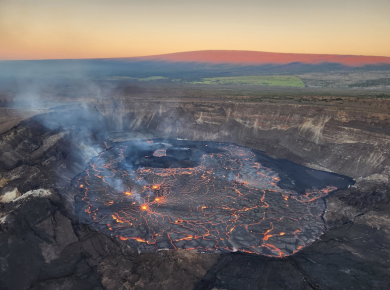
Liquid Rock at Pu'u O'o

And the answer is yes, at least for the moment. Be aware that conditions can change at any moment. So, let me help clear up confusion about seeing liquid rock on the Big Island. Here are some frequently asked questions.

Where is the active lava now?

Let me give you the long term answer for that. The US Geological Survey maintains websites with very useful information on volcanic activity. The best place for getting lava flow updates in layman’s terms is on their Kilauea Images site. They also have a daily volcano update that’s good, too, though it’s written in a little bit of “scientific-ese.” You can also find an updated map of the lava flow which gives you an idea of where and how the lava is flowing. One last interesting point about the current flow, is that none of the lava activity is inside of Hawaii Volcanoes National Park.

I want to see the active lava. Is there any way to see it?

As of March 8th, a lava viewing point was created off of Hwy 130. Lava flow and conditions are subject to change at any moment.  Check the Hawaii Volcano Observatory daily update reports for Kilauea.  If the lava flow changes to an inaccessible area, your best bet to see the lava is by helicopter tour.  Call 808-961-8093 and/or 808-935-0031 for updates.  Currently, pilots and tourist are reporting that the views are fantastic, too. According to the Big Island Visitors Bureau, “Helicopter and fixed-wing aircraft tour companies in Hilo and Kona are reporting a huge surge in demand – and some of the most spectacular flight-seeing imaginable.” So, if you are considering a helicopter tour on the Big Island, you should do your homework and book a tour ahead of time. (See more helicopter tour tips and also get an idea of what a helicopter tour is like on the Big Island.)

If I can’t see lava flowing, is it still worth going to Hawaii Volcanoes National Park?image

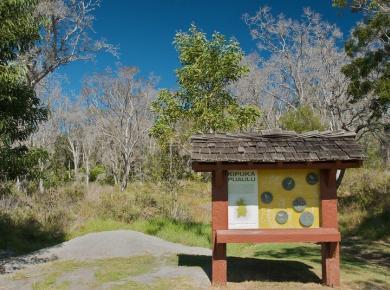
My answer is absolutely, yes! Who would have thought that acres and acres of black hardened lava could be so interesting? There really is a lot to see and do from hiking in forests and across an inactive volcanic crater, to the Thurston Lava tube, and much, much more. Where else will you see an interesting sign like the one on the right?

Is lava flowing to the ocean?

March 7th update: The lava is currently flowing to the ocean.

Where will the lava be flowing in the future?

Ah, one of the most fascinating aspects of a volcano is that you can’t predict what it will be doing next. In the last six months or so, lava was flowing to the ocean and then it suddenly stopped. The Pu’u O’o vent was a huge impressive lava lake, and then it quit. Then in July, a new fissure popped up, the July 21st Eruption. In recent days the lava was flowing very slowly towards the ocean and then suddenly started flowing at a rate of a half-mile per day. Who knows what will happen next?

I hope this article has helped you from being tricked by the flashy ads and miscommunication that would make you think you can just take a 10 minute hike out to see the lava flow.

If you’ve been reading Go Visit Hawaii for a while, then you know that I’m an admitted volcano nerd :-) and that one of my favorite Hawaii hikes is Kilauea Iki. From my post on the hike, you may recall that I mention the 1959 eruption that generated fountains of lava that reached up to 1,900 feet in the air. Well, I was blown away at this YouTube video with footage of that eruption. This high quality video lasts ten minutes and is well worth the time to watch it. I was amazed.

Sheila

Life from Lava

Life from Lava

Here at Go Visit Hawaii, I like to create a virtual visit to Hawaii as often as possible. I love looking through my photo collection. As I looked through my photos of the Big Island today, I was inspired to take you on a virtual visit to the lava fields of Hawaii Volcanoes National Park. In the park you’ll see acres and acres of hardened black lava. Sometimes you’ll find a field of lava with dots of green. Those green dots are plants that are determined to anchor down and recreate the rainforest that thrived there before lava destroyed it. Isn’t it amazing?

Hawaii Volcanoes National Park

Hawaii Volcanoes National Park has issued a press release concerning the closure of trails and pullouts along Crater Rim Drive.  Elevated levels of sulfur dioxide gas in the Kilauea summit area have prompted the following closures:

  • Crater Rim Drive from Jaggar Museum to Chain of Craters Road will be opened for drive through visitation only, no parking or stopping allowed at any pullouts, parking areas or shoulders.
  • Crater Rim Trail from Jaggar Museum to Chain of Craters will be closed.
  • All trails leading to the summit caldera of Kilauea are closed. 

Elevated volcanic gas levels are dangerous to everyone. In these areas, do not stop and do not leave your car. Drive by with car windows rolled up and use air conditioning in “recirculation” mode.

The SO2 levels are the highest they’ve been in since 1982 per this Star Bulletin article.  Elevated exposure to SO2 can cause breathing problems and it is particularly dangers to children, pregnant women and those with asthma and heart conditions.  When mixed with water, SO2 can become sulfuric acid.  As you probably know, the lungs contain water. 

I’ll try to keep an eye on when the restricted areas reopen.  It is always a good idea to limit your exposure to SO2 anytime you visit Hawaii Volcanoes National Park.  You will know when you are around it, particularly by it’s foul (rotten egg) fragrance and you will see white fumes coming from the ground. 

As a final reminder, always begin your day at the park with a stop at visitor center.  Check there for any closures, dangers, and safety advice for your visit.

image

This “No Parking” sign stands firm in hardened lava as a reminder of how powerful and unpredictable Kilauea volcano is.  You can find this sign at the end of Chain of Craters Road in Hawaii Volcanoes National Park.  In 2003 lava created a natural end to the Chain of Craters Road when lava flowed from the East rift across the road and into the ocean. 

image

For a map and tips on seeing the sights around the Chair of Craters Road and Crater Rim Drive, you can print this free brochure provided by Hawaii Volcanoes National Park.

image Where else but in Hawaii can you hike through a beautiful rain forest and then across a volcanic crater floor all in the same hike? This unique hike is one of my favorites in Hawaii. It’s called the Kilauea Iki hike and it is located on the Big Island in Hawaii Volcanoes National Park. It is truly amazing to go through the contrast of environments, from the rich rain forest to the crater with plant life barely dotted along the floor.

Kilauea Iki had been inactive for nearly a century when it erupted in 1959 for 36 days. If you take this hike, imagine the lava shooting up more than 1,900 feet which is four times the height of the crater walls. To learn more about the history of Kilauea Iki and see some fascinating photos taken during the eruption, see this link to the Hawaiian Volcano Observatory.

image This 4-mile loop hike starts near the crater’s rim and descends 400 feet down to the crater floor. The path cuts directly across the crater floor before climbing back up along the crater’s rim. It is considered to be a moderate hike that should take two to four hours. You’ll find this trail off of Crater Rim Drive near the Thurston Lava Tube.

I highly recommend this hike if you have the time available as you explore Hawaii Volcanoes National Park. Please note that there is a $10 per car fee for entrance into Hawaii Volcanoes National Park. That fee allows entrance in to the park for seven days. If you go, be sure to check in at the visitor’s center to verify that the trail is open and check for any hazards. Bring water and wear comfortable hiking shoes. If you’re not up for the hike, there is an overlook there for you to take a peek at the impressive crater.

There’s a great brochure on this hike and more about this fascinating crater here.

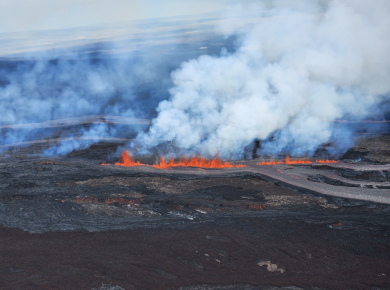
image According to the Honolulu Advertiser, the most recent lava eruption on the Big Island of Hawaii is “offering the best daytime lava viewing opportunities for airborne tourists in years.”  A Hilo pilot told the Advertiser that, “I’ve been doing tours from Hilo for seven years, and this is the best lava flow I’ve ever seen.”  The above ground stream of lava is currently about four miles long and the only way to see it is by air.  As a result, air tour business is booming.  From my own experience, I can highly recommend taking a helicopter tour to see the active eruption.

If you are on another Hawaiian Island for vacation and feel so close yet so far away from seeing an active volcano, consider taking a day trip to the Big Island.  Inter-island flights are relatively inexpensive at about $80 round trip.  You can fly into Hilo and pick up a helicopter tour from there.  To make the most of your day trip consider renting a car at the airport (all the major rental agencies are there) and drive out to explore Hawaii Volcanoes National Park on the ground. 

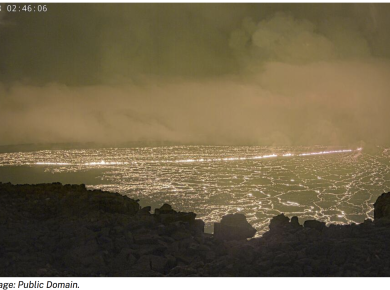
Can’t get to the Big Island to see the lava flow?  Then take a virtual visit.  You can see the live panoramic view of the lava flow via web camera.  If possible try to catch glimpses during Hawaii’s night time when the red glow from the lava is more visible and dramatic.

Photo credit to USGS Hawaiian Volcano Observatory

  • What’s going on under Kilauea Volcano on the Big Island?  There were two earthquakes last week, the first at a magnitude of 5.4 and the other at 4.4.  In addition, a 44-acre lava bench fell into the ocean.  Scientist are unsure if one of the earthquakes or Hurricane Flossie could have caused the collapse.  Meanwhile, lava continues to flow from the July 21st fissure eruption.  
  • The Hawaii Superferry is set to launch on August 28th, but there are two legal hurdles in the way.  The opposition to the ferry raise concerns about the environmental and traffic impacts.  One legal challenge goes before a judge tomorrow and the other on Thursday. 

« Prev - Next »